|
<< Click to Display Table of Contents >> Finding duplicates |
  
|
|
<< Click to Display Table of Contents >> Finding duplicates |
|
A simple way finding duplicates on a selected field as e.g. the "Id" field:
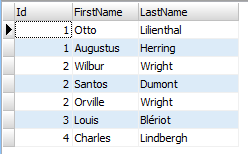
From this statement including a simple subquery
SELECT
id
, FirstName
, LastName
FROM "Names"
WHERE id IN
(
SELECT
id
FROM "Names"
GROUP BY id
HAVING
COUNT(id) > 1
)
ORDER BY id;
you will get a list of records with the duplicate "id" field values:
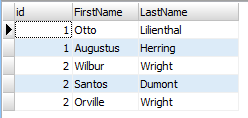
You may also write the statement using a correlated subquery like:
SELECT
T.id
, T.FirstName
, T.LastName
FROM "Names" T
WHERE EXISTS
(
SELECT
Tdup.id
FROM "Names" AS Tdup
WHERE Tdup.id = T.id
GROUP BY Tdup.id
HAVING
COUNT(Tdup.id) > 1
)
ORDER BY T.id;
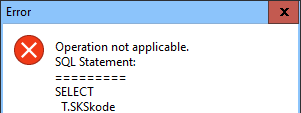
working equally well on small datasets, but which on large tables will be significantly slower, and maybe even with a response like this:
If you want you to also get the duplicate count numbers, with Paradox you will need to use a JOIN design using a disc stored SQL statement, as BDE/Paradox does not provide temporary MEMORY tables or SQL VIEWs and has only limited capabilities using subqueries.
First you will need to create an SQL like this:
SELECT
id
, COUNT(id) AS IdCounts
FROM "Names"
GROUP BY
id
HAVING
COUNT(id) > 1
;
and save it as e.g. Names-IdDups.sql. You may store it in a sub folder .\SQL relative to the database directory.
Next, you will create an SQL statement like this joining the Names-IdDups.sql to get also the duplicate count numbers:
SELECT DISTINCT
T.Id
, Tdup.IdCounts
FROM "Names" AS T
JOIN "SQL\Names-IdDups.sql" AS Tdup
ON T.Id = Tdup.Id
ORDER BY T.Id ;
and you will get this:
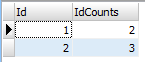
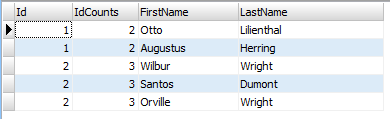
or for the full list of duplicate field records:
SELECT
T.Id
, Tdup.IdCounts
, T.FirstName
, T.LastName
FROM "Names" AS T
JOIN "SQL\Names-IdDups.sql" AS Tdup
ON T.Id = Tdup.Id
ORDER BY T.Id ;